Visit to the 31°N 7°W confluence
The Team
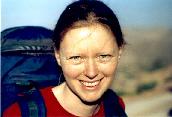
Dr. E.J. Minay of London, United Kingdom.
Ir. G. Busker of London, United Kingdom.
We decided to take our holiday in Morocco and by sheer chance I found the degree confluence home page shortly before we left. I was going to take a GPS unit (Magellan GPS Pioneer) in any case and when we did indeed have to stay over in Ouarzazate on 29 April 2001, we decided to attempt the confluence.
The area
Ouarzazate is a fair sized town at the confluence of the Ouarzazate, Dadès and Drâa oasis systems. Most visitors will spend a night there en route between Marrakesh or Agadir and the oases south of Er Rachidia or the Drâa valley.
Since we were coming from Erg Chebbi and planning to cross the Atlas mountains from the south to Marrakesh, we decided to take a break in Ouarzazate to relax and possibly attempt the 31N° 7W° confluence on foot.
The 31°N 7°W confluence lies just over 12 Km (7-8 miles) from the center of Ouarzazate. The proximity of the town led us to believe that this may be a Moroccan confluence in a populated area. Observations from the roof of our hotel showed a cluster of houses far out in the direction of the confluence.
The trip
We set off at 8:30 and decide to follow the main road to Marrakesh and Agadir (Avenue Mohammed V) out of Ouarzazate in a W-NW direction. This way we would not have to crawl through the suburbs where troops of children would come and ask us for bonbons and pens.
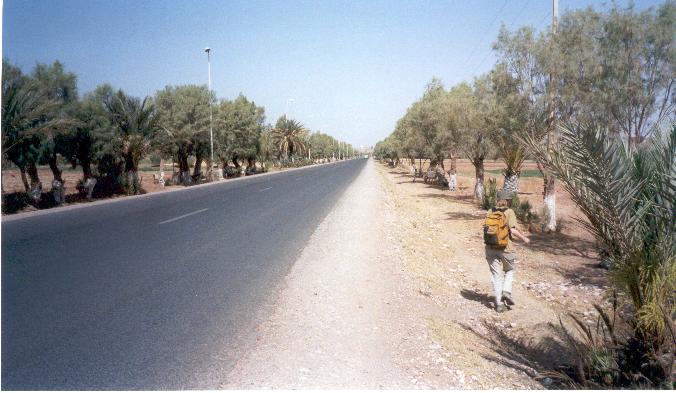
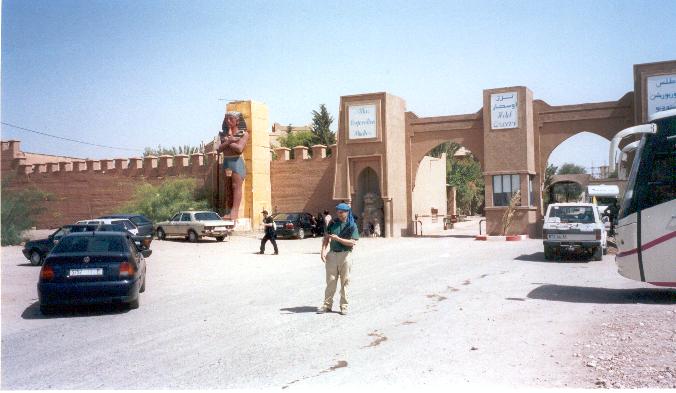
At 10:00 we are at the outskirts of Ouarzazate and we reach the “Atlas” film studio which really looks like a film studio junk yard. Several large Egyptian “stone” pillars and the side of a ship are stored here. It looks like our confluence is in or behind a pass between two mountains a few kilometers to the north. We leave the road and a little boy follows us and asks for a dirham, a cahier, a stylo and whatever else he can think of. He disappears and returns and doesn’t leave us alone. I ask him what the name of the two mountains is and he writes it down for us: “Tiknim” (or something like that. I’ll get the Arabic translated). I tell him to keep the pen and he goes away.
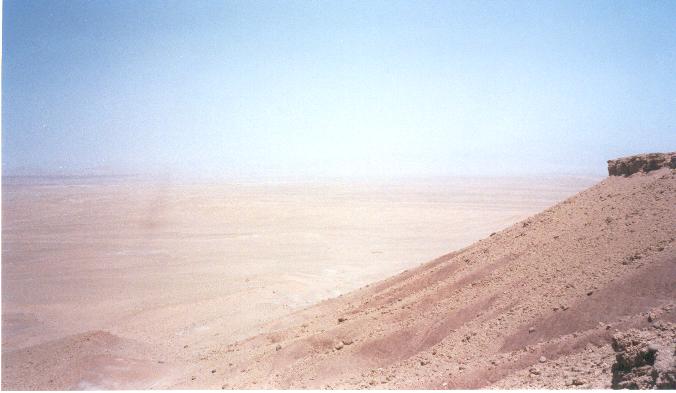
The “pass” turns out to be a big gorge and we climb the westerly peak and have lunch at the top. It is getting quite hot now and the breeze at the top is very welcome. Below is a desert valley in which the confluence lies. There is very little green vegetation and the desert looks very rocky. The valley seems to continue all the way to the Atlas which can be seen in the distance.
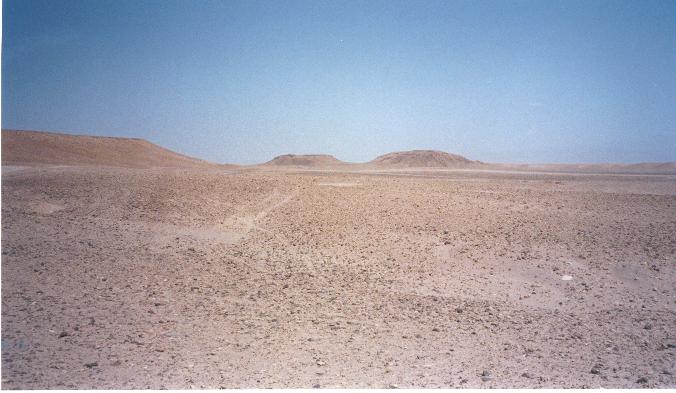
We descend the mountain into the valley and follow several small dry river beds that lead onto the plains. Here the ground consists of small rocks, flattened by what look like track marks left by heavy tanks. We find several shell remains and blown up car wrecks. About 1 Km before the confluence a troupe of quad bikes turns up. With relief we find that it is a group of tourists, led by a Moroccan guide and not the military police, out to arrest us for entering a secret missile testing area.
The confluence
The confluence is probably a typical example of Moroccan desert; rocks with few desert plants and an empty plastic container just 100 meters to the west. Ouarzazate is not visible from the confluence although some trees can be seen in the south-east and I am certain the city lights will be visible at night. A dozen blown-up car wrecks can be seen a mile away in this direction too. To the south the two peaks of “Tiknim” (?) are clearly visible. The start of the Atlas mountains is maybe 20 Km to the north.
Views from the confluence
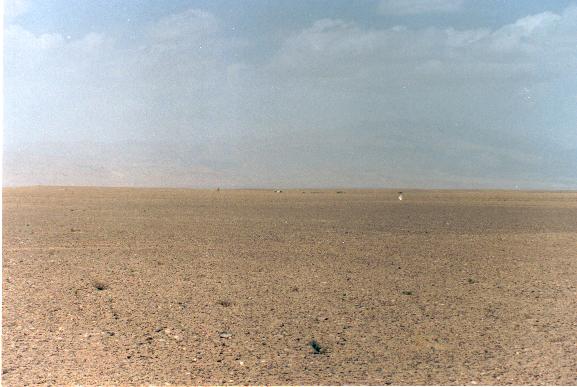
To the north: The Atlas mountains.
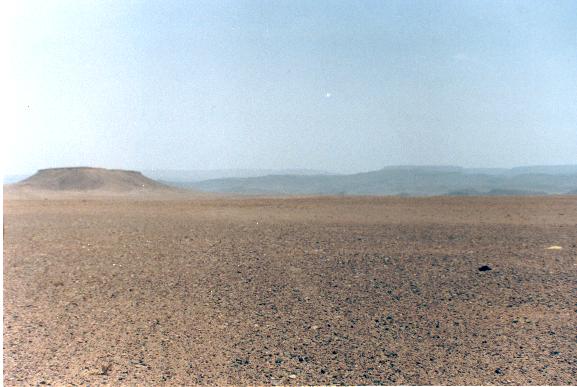
South: Hills and the main road to Agadir and Marrakesh
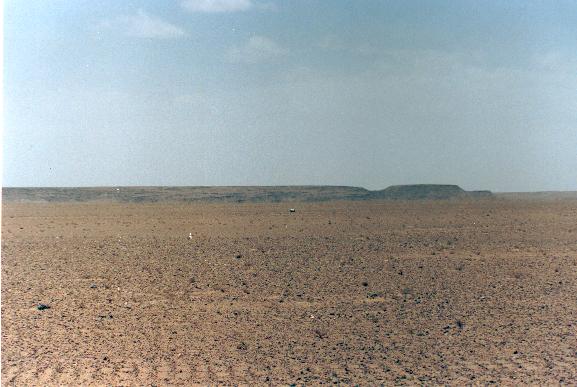
West: More hills and a plastic container
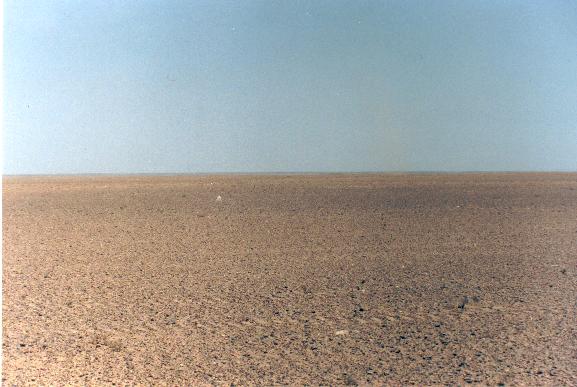
To the east: desert
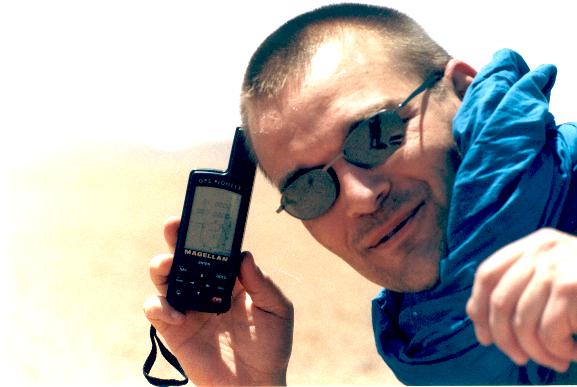
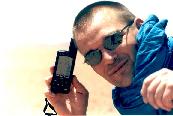
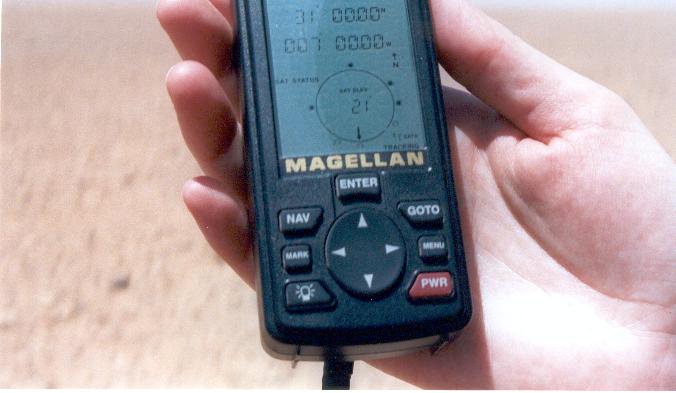
Me standing at the confluence with GPS
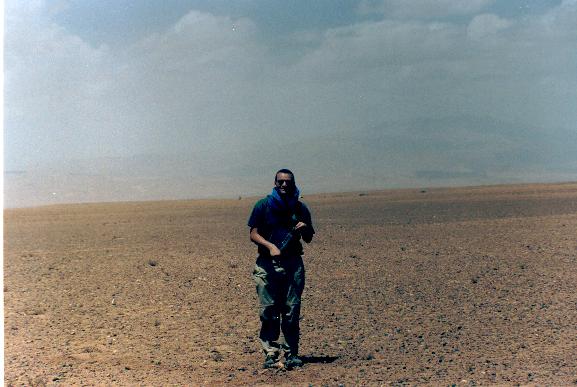
North
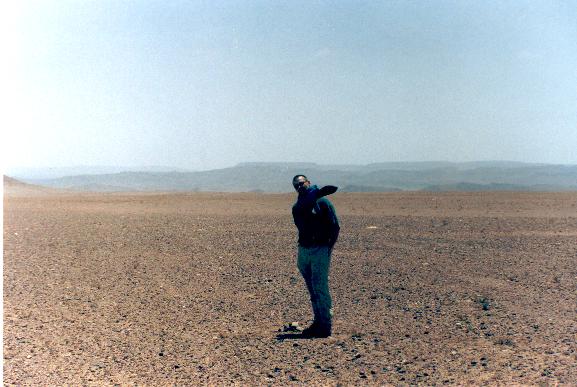
South
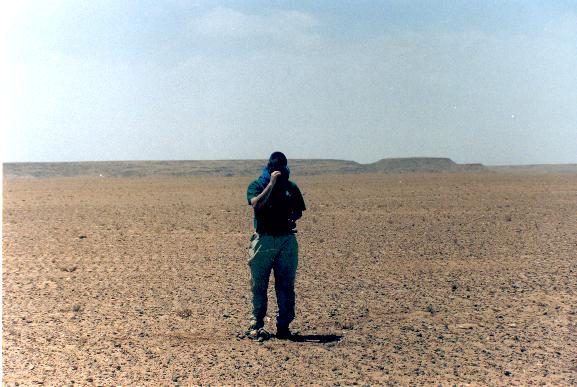
West
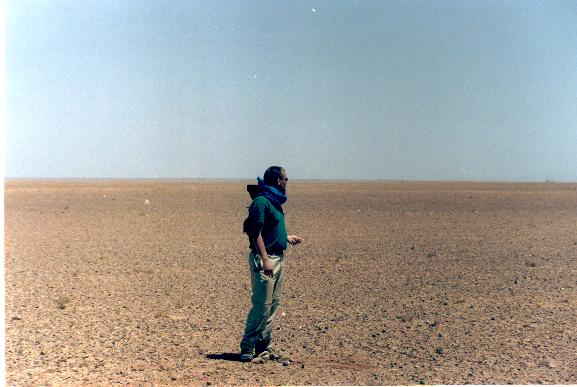
East
The way back
We decide to take a more direct route back by aiming straight for our hotel in the town. We pass many blown up and burnt out car wrecks, bits of exploded shell and there are tank tracks everywhere. We hit a road a few hours later and take a taxi back to our hotel. We eat in cafe-restaurant “Renaisance” and sleep very well that night.
References
- “Morocco”, Barnaby Rogerson, Cadogan, 2000.
- “Morocco – The rough guide”, Mark Ellingham, Shaun McVeigh and Don Grisbrook, Rough Guides, 1998.
Leave a Reply